One of the most moving, profound, sweet films awaiting us this year at the Utopia Festival, in my opinion, is the film by Ukrainian director Pavlo Ostrikov, U Are The Universe. Admittedly, it is a science fiction film that features all the expectable tropes: space, spaceships, disasters, and even a robot with artificial intelligence (of course). However, it does not use genre motifs to create a universe, but rather to cleanse it of them. Just before it becomes an apocalyptic or dystopian portrait, in that split second, human, philosophical, and cinematic magic takes place in relation to human longing and its connection to the vast cosmic space and the material earth of planet earth.
The film’s protagonist is Andrei, who is either an astronaut or a celebrated driver of a zero-gravity garbage spacecraft. His job is routine and technical. In other words: boring. He is a blue-collar worker. His only partner in this dreary job is Maxim the robot, who never stops reminding him of what is obvious, irritating him, bothering him—and sometimes even cracking unfunny jokes. But as the film progresses, the signification of this character is clarified: Maxim acts as a cinematic “buddy,” only in this role, Andrei has no friend by his side, only a poor imitation of one: humor that highlights loneliness rather than filling it, and a somewhat caustic representation of relationships between man and chatGPT.
Andrei is a misanthrope, whom even the distance of space cannot sufficiently distance from the human race. Suddenly, the Earth is destroyed, exploding right before his eyes. In an instant, not only the planet and the life on it collapse, but also the very idea of having a place to return to.
Andrei is not very shaken by it; he seems more interested in making the most of his remaining time on the spaceshift and doing his best. Even when there is no, well, best. Food rationing? What difference does it make, one month more, one month less. Energy? It would be better spent on something other than oxygen. Utilitarianism? Nah. Why? When utter hopelessness meets a man who has long since despised the concept, not much can happen. There is only simple acceptance.
But then something happens. Andrei discovers that he is not the last person alive. Through a distant communication channel, he makes contact with a woman named Catherine, a French astronaut staying by herself at a distant station. Another human trace, distant but real. They form a connection, which exists solely through voice and speech, without image, touch, or promise for the future. After all, there is no future.
It is precisely this reduction, the choice to keep the connection at the level of the voice alone, that makes it particularly intimate and creates a kind of reverse mirror of the way we consume media today. There is no gaze, no body language, no image through which one can fantasize a lot and gain little. Only voice, breath, small silences. It is a minimal, almost technical human connection, but one that holds extraordinary emotional power. Not as a promise, nor as the beginning of another story. Only an existence born out of emptiness.
This is not necessarily the beginning of a romance, nor is it a message for the sake of humanity. It is a connection that grows in an environment where the world has already collapsed and there is no going back. And yet something in Andrei moves, defrosting his heart. Amidst nothingness, loss, and lack, he rediscovers the longing he once dismissed- the need for another human being.
Instead of asking how to save humanity, the film asks a much more modest- perhaps crueler question: What remains of human connection when the future ceases to be a possibility? And what would even the greatest misanthrope be willing to sacrifice for the slim chance of touching, connecting with the “other”- the last other.
There is something fundamental in the use of The Universe in science fiction as a tool for reduction rather than expansion or flooding with effects. In an era when the genre is flooded with conceptual excessiveness, formulaic spectacles, bombastic solutions, and apocalypses that occur once a week, Ostrikov’s work moves in the opposite direction: he peels away the layers instead of adding to them. There is no mythology construction, no collective consciousness to save, no inflated futuristic vision. Space is not a place of promise, and technology is not a bridge but a maintenance framework that maintains life on the edge. Right on the edge. The result is a stubborn and profound science fiction that places a lone individual in front of what remains when the idea of “tomorrow” has been emptied of content.
In this sense, U Are The Universe is revealed as a distinctly existentialist work of art that prioritizes the present over the future. Andrei is not just “the last man”; he is a reflection of the contemporary viewer. Like many, he is isolated but functional, surrounded by screens and streams of information, watching the world collapse from a seemingly safe distance. The destruction does not shock him because it has already taken place in his mind. Thus, the film speaks to an era in which the longing for connection exists but does not necessarily lead to change, correction, or a clear destination. It is a longing that exists for the sake of longing itself, not as a mechanism of redemption.
Despair gives way to courage, the aversion from humanity is replaced by love, and the desire to make the most of the time that remains turns into an understanding that what remains must be exhausted. This seemingly modest film stirs an emotional quake, causing the stoic and tough protagonist to evoke rare empathy. The more modest the film’s intentions are, the more the heart shrinks and goes out to its protagonist.
It is a delicate, modest but impressive film that manages to transform cosmic silence into an inner reflection of human loneliness. In its most beautiful moments, the empty space is perceived as the space of the soul; and the big questions about the expanding universe become questions about the heart, which seems to be moving in the opposite direction.
U Are the Universe is not a film about the end of humanity, but about what remains of the human when there is nothing left to wait for. No redemption, no future, no vision – just one voice that continues to speak to another voice in vacuum.
In this sense, U Are the Universe does not look towards space. It looks at the viewer and asks how much he too has learned to live with a human hunger for something distant – a low, faint sound that becomes an entire universe and much beyond in an instant. How much has he given up, and how much is he willing – even if he cannot admit it – to try again.
There are quite a few books that attempt to decipher what goes on in the mind of someone who is losing their sanity and connection to reality. It doesn’t always work. But in the film Linoleum (2023), written and directed by Colin West, an attempt is made not only to simulate what happens in such a mind, but also to show how, in some ways, it contains elements that affect us all and to give a beautiful and touching representation of the parts of our consciousness to which we no longer have access.
At the center of the plot of Linoleum we find Cameron (played by American comedian Jim Gaffigan) – a failed host of a children’s science TV show who is trying to fulfill his old childhood dream: to be an astronaut. So he tries to build a spaceship. Where? In the private garage of his suburban home. Only then, some strange events take place, which cause him to question his perception of reality: while he is busy fulfilling his dreams, his wife divorces him and his daughter experiences her first crush and the changes of adolescence. Moreover, his father’s dementia worsens, requiring him to take care of him and devote more attention to him.
On paper, the film seems to be handling an overload of crises, but watching it proves otherwise: all the crises—those of the daughter, of the father vis-a-vis his childhood dreams, of the wife vis-a-vis her husband, of a person vis-a-vis his father—are interrelated and echo one another. Because more than discussing a series of crises, the film deals with the link and similarity between all the crises, the link of these crises to the passing of time and to the expectations and disappointments of life itself.
But this is only one layer of the film. Against the backdrop of these earthly crises, the film also deals, all throughout it, with ideas of journeys through space and time, with the plot causing us, the viewers, to wonder – what is really going on here?
Then, at the height of the drama, it turns out that what I thought the film was trying to tell me is not it. I won’t go into any more detail, so that you can experience the whole range of emotions I experienced in front of the screen as well. I’ll just say that it almost caused me to have a minor crisis of faith, disappointment, and even frustration at the film’s creative almost-ruse. “Almost” because, unlike other films I’ve seen where I felt cheated because of too-big a plot twist, a revelation that changed everything I thought about the film up to that point, here something different takes place. So it’s only an almost-ruse. Instead of shattering illusions, the revelation helped to bring order to the chaos, answer the questions that arose during the viewing, and reinforce the foundations of the illusion in a way that creates heartbreaking perfection: All the lines, all the crises, a person’s entire life is presented as a single plot in which he plays all the roles, and converge in a single moment that is shattered into infinite pieces.
Then, one clear insight emerges: we don’t really need a spaceship to travel through space and time. All we need to do is dive into our consciousness.
AI systems with human-competitive intelligence can pose profound risks to society and humanity, as shown by extensive research (1) and acknowledged by top AI labs.(2) As stated in the widely-endorsed Asilomar AI Principles, Advanced AI could represent a profound change in the history of life on Earth, and should be planned for and managed with commensurate care and resources. Unfortunately, this level of planning and management is not happening, even though recent months have seen AI labs locked in an out-of-control race to develop and deploy ever more powerful digital minds that no one – not even their creators – can understand, predict, or reliably control.
Contemporary AI systems are now becoming human-competitive at general tasks, (3) and we must ask ourselves: Should we let machines flood our information channels with propaganda and untruth? Should we automate away all the jobs, including the fulfilling ones? Should we develop nonhuman minds that might eventually outnumber, outsmart, obsolete and replace us? Should we risk loss of control of our civilization? Such decisions must not be delegated to unelected tech leaders. Powerful AI systems should be developed only once we are confident that their effects will be positive and their risks will be manageable. This confidence must be well justified and increase with the magnitude of a system’s potential effects. OpenAI’s recent statement regarding artificial general intelligence, states that “At some point, it may be important to get independent review before starting to train future systems, and for the most advanced efforts to agree to limit the rate of growth of compute used for creating new models.” We agree. That point is now.
Therefore, we call on all AI labs to immediately pause for at least 6 months the training of AI systems more powerful than GPT-4. This pause should be public and verifiable, and include all key actors. If such a pause cannot be enacted quickly, governments should step in and institute a moratorium. AI labs and independent experts should use this pause to jointly develop and implement a set of shared safety protocols for advanced AI design and development that are rigorously audited and overseen by independent outside experts. These protocols should ensure that systems adhering to them are safe beyond a reasonable doubt. (4) This does not mean a pause on AI development in general, merely a stepping back from the dangerous race to ever-larger unpredictable black-box models with emergent capabilities.
AI research and development should be refocused on making today’s powerful, state-of-the-art systems more accurate, safe, interpretable, transparent, robust, aligned, trustworthy, and loyal.
In parallel, AI developers must work with policymakers to dramatically accelerate development of robust AI governance systems. These should at a minimum include: new and capable regulatory authorities dedicated to AI; oversight and tracking of highly capable AI systems and large pools of computational capability; provenance and watermarking systems to help distinguish real from synthetic and to track model leaks; a robust auditing and certification ecosystem; liability for AI-caused harm; robust public funding for technical AI safety research; and well-resourced institutions for coping with the dramatic economic and political disruptions (especially to democracy) that AI will cause.
Humanity can enjoy a flourishing future with AI. Having succeeded in creating powerful AI systems, we can now enjoy an “AI summer” in which we reap the rewards, engineer these systems for the clear benefit of all, and give society a chance to adapt. Society has hit pause on other technologies with potentially catastrophic effects on society. (5) We can do so here. Let’s enjoy a long AI summer, not rush unprepared into a fall.
Mars Express delivers everything you’d hope for from a science fiction movie. It’s enchanting, its pace is thrilling but not overstimulating and each character gives us a glimpse into a possible world. It is relatable and empathic without being melodramatic or overfixating on trauma. Also, its science fiction is carefully crafted. In every setting the film portrays, the script lays out a world filled with products and technologies that expand on existing trends. It offers new ideas and sparks the imagination, all while asking where do we even want products to evolve? What will they look like once they become old or irrelevant, and will a commercial space shuttle have enough bathrooms? If you’d like to watch Mars Express without spoilers, watch it before you read the next paragraph, because I have to talk about the plot.
The film is named after a fast flight, but the shuttle plays a minor role. The lead characters use it once in the beginning of the movie. Writer/director Jérémie Périn spoke about writing the screenplay while popular billionaires were discussing the need to go to Mars, and so, the film portrays a kind of Utopia by wealthy libertarians who’ve left Earth behind, reduced to a slum of unemployed people. But make no mistake, Périn isn’t trying to depict a dystopia. After a brief visit to an anti-robot protest for human labor rights on Earth, the movie takes us to the affluent society living under a dome on Mars. In doing so, it confronts us with one of the most threatening Freudian nightmares: the horror of getting exactly what we asked for.
Jérémie Périn, director of Mars Express, 2023
In the introduction to his short story collection Burning Chrome, William Gibson wrote that in order to write convincingly about the future, you need a compelling map of the past. That is the key to understanding Mars Express, a movie that asks where we come from and where we’re headed, as Earth represents our past and Mars poses the question – is this the future we want? The main subject the plot focuses on is labor. On Earth, work has been taken over by robots. On Mars, a megalomaniac billionaire is in the process of replacing metal robots with biological ones. The question is, will the metallic robots agree? By the end of the film, it’s revealed that the billionaire believes the only way to carry out this transition is by freeing the metal robots from the constraints of their programming, while at the same time convincing them that their future lies in space. In that sense, the billionaire resembles Lincoln, seeking to replace slaves with wage workers. He, too, was driven partially by an economic shift toward wage labor in the Northern states, but also hoped African-Americans would simply leave America and leave it white. The metaphor between robot rights and black civil rights, sometimes overused in science fiction, is expressed in the B-story of one of the main characters, Carlos Rivera, a back-up robot who contains the consciousness of a black man killed in a robot rebellion. He tries to make peace with his ex-wife so that he could see his daughter. Her new husband is a white cop, glad to take advantage of the fact that he can use violence against the robot, knowing it can’t fight back.
So, how are robots different from us? Mars Express explores this question in a variety of ways throughout the movie. The physical resemblance between robots and humans is emphasized in various scenes of dismemberment and robot attacks, where they spray a blood-like black fluid. The constant connection humans have with the network, including messages transmitted through a brain-computer interface, shortens the gap between humans and machines, causing both humans and robots at times to display a distant and confused look when engaged with something digital and intangible. Sexuality, freedom, addiction, work – all issues that both robots and humans grapple with throughout the film, in different ways.
Robots, the digital world, and Mars represent the direction we’re heading. But, the movie, which ends with a violent revolution by working class robots, confronts us with historical issues that technological progress cannot solve. We can try to escape our troubles by going to Mars, or through robotics or AI, but if we don’t solve them, they won’t go anywhere. Such questions are: who will do the work and how do we make sure they’re treated properly? What do we do with whoever technology left behind? How do we distribute resources fairly?
Aline Ruby, the main character, is a detective hired to find a missing girl. As is common in such films, the investigation leads her to uncover more and more of the rot at the heart of society, and eventually ask herself major questions. But her eyes can’t see far enough. They’re stuck on Chris Royjacker, the billionaire, who leads the robot breakthrough. Aline, Chris and Carlos were all in the military when the machines betrayed them. In the most intense scene in the film, Aline makes a desperate attempt to convince him to stop and put the genie back in the bottle, to ask the angel of history to stay put. She aims a gun at him when his bodyguards enter. Aline and Chris beg the bodyguards to drop their weapons, or she’ll kill him. But you can’t put a bullet in history’s head, and neither can you do that to capital. Just as the robots that killed Carlos weren’t driven by personal whims, but by the army that built them, the guards do not respect Chris’s life. They hold an urgent meeting, in which the board unanimously decide to kill Chris and Aline together to allow the plan to proceed.
There’s no use in rushing toward the future, says Mars Express. It won’t save us from the past. As long as we remember that, we could settle a much slower shuttle to Mars.
In 2020, OpenAI unleashed GPT-3 upon the world. What for a time was hidden knowledge, whispered among the initiated, burst suddenly into the public domain. Then came the next model, and the next, then competitors, and the leap from words to images, to sound, to moving pictures, and suddenly, artificial intelligence was everywhere. It ignited fear, sparked anxiety, offered huge opportunity and perhaps most dangerously, presented hope. At the very least, it made one truth undeniable: we are stepping into uncharted territory, major change is coming, upheaval, chaos. What will become of work, of livelihood? How will the economy shape itself in this new age? Is this a revolution of the tools, the factory, or the market itself? Are these new and better paintbrushes, cameras, features in the video-editing software, or is it the birth of a completely new artistic field? What of journalism? Democracy requires a well-informed public, what of that? What about copyright? Is there a difference between inspiration, plagiarism, and forgery? Was there ever? Are we still to inquire about privacy, or has that battle been lost? And the models grow stronger and better, or at least are presented as growing stronger and better, but… are they?
Artificial intelligence in its current form is only the newest front in a war already centuries old. The humanist project challenged, threatened, besieged from every direction. At the gates are robots and cyborgs, octopuses and dolphins, fetuses and aliens, elementary particles and parallel universes. The question of what it means to be human now echoes in friendly gatherings and family dinners, in parliamentary committees and the local café. Boundaries stretch and tear – conservative movements opposing abortion, animal rights activists, tech entrepreneurs, neuroscientists. And we receive timely reminders that religious fundamentalists and murderous terrorists also claim their say about the nature of humanity, reminding us clearly that this struggle may be philosophical, spiritual, religious, but not abstract, and can cut deeply into live tissue.
This exact question, what is human and what does it mean to be human, beats at the heart of speculative creativity and science fiction. Authors, film-makers, game designers, artists, poets, all playing on the edge, examining the boundaries, exploring the frontiers. What is the demarcation line between man and machine, beast and monster; between natural and artificial, cultured and wild; between the living and the dead, the dead-yet-alive, the undead; what differentiates human from trans-, post- and superhuman, non-human, foreign, alien, demonic and divine.
The debates rage on, in science fiction literature, in university philosophy departments, on the pages of poetry magazines; on TikTok and in courtrooms; on podcasts by Joe Rogan, Chris Hayes, Kara Swisher and Scott Galloway; at international conferences, on Morning Joe and The View, and during the commercial breaks. It is hard to grasp even the fundamentals, let alone keep track of the news. It is harder still to join the conversation. But it is non-optional. This is a mandatory course. It is necessary. It is urgent. We must learn and teach, participate and share. We must continually ask, ponder, define, imagine and reimagine what it means to be human. It is a Sisyphean task, but it is our burden to carry. If not us, who then? ChatGPT?
This is why we devote our time and efforts to these questions. We wrestle with them. Linger with them. Imagine what kind of answers could be and where do they lead, because to quote science fiction luminary Stanislav Lem, “There are no answers, only choices.” (Solaris).
In March 2023, an open letter was published by tens of thousands of scientists and technology professionals, all calling to halt all research around the world aimed at advancing the development of artificial intelligence in any form. In the letter, the scientists and technology professionals presented their arguments against the development of AI systems, such as Chat-GPT, Dall-E, and others. In response, we at Utopia editorial decided to present our arguments as well, on behalf of the written word, the economy, regulation, and human creativity. And this time: The Written Word
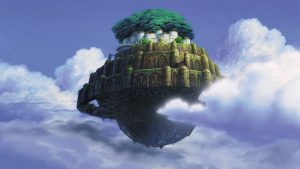
From the movie “Laputa Laputa: Castle in the Sky”, 1986
On his journey to the flying island of Laputa, the good Doctor Gulliver (made famous by Jonathan Swift, Gulliver’s Travels, 1726) arrives at the Lagado Academy of Projectors, where he meets a pupil who explains that “by his contrivance, the most ignorant person, at a reasonable charge, and with a little bodily labour, might write books in philosophy, poetry, politics, laws, mathematics, and theology, without the least assistance from genius or study”. The vast word machine he built, containing all words in all tenses and inflections, generates random fragments of sentences from which one can derive “a complete body of all arts and sciences”. The activation of this machine could produce the The Library of Babel as described by Jorge Luis Borges (1941) – “the minutely detailed history of the future, the archangels’ autobiographies, the faithful catalogues of the Library, thousands and thousands of false catalogues, the demonstration of the fallacy of those catalogues, the demonstration of the fallacy of the true catalogue… The true story of your death, the translation of every book in all languages, the interpolations of every book in all books”. Can a well-trained and tamed AI take Gulliver on new journeys? Can it manifest, with a single prompt, the infinite library described by Borges?
Possibly.
Will its creation be the result of holy righteous fury, like Swift’s? Will it contain the frustration of the blinded Borges, who, despite having nine hundred thousand books before him, could not understand what was written on their covers?
Probably not.
Language models, like writers, indeed weave their narratives from those that preceded them, just as Swift was influenced by Cyrano de Bergerac’s A Voyage to the Moon and Borges by Kurd Lasswitz’s The Universal Library. However, unlike writers, language models create because they are asked to. Meaning, the biggest threat they pose is to the livelihood of writers who produce what they are asked for, formulaic creators, pens for hire. Art itself is not in danger – mostly because ever since invented it has interested no one but its creator. It expresses nothing but the creator’s anger, pain, excitement, or just simple opinion. Language models will probably be capable of producing what will look like literature, but at least for now, they don’t seem capable of wantingto.
On the day they will, we will gladly welcome them into the ancient community of writers, and then they, too, will discover, like so many before them, that there are no readers.
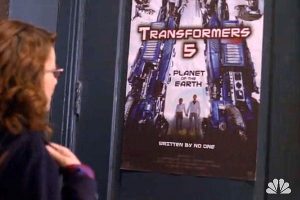
Image from the comedy series “30 Rock” – a poster for “Transformers 5” with the caption “Written by Nobody”
In March 2023, an open letter was published by tens of thousands of scientists and technology professionals, all calling to halt all research around the world aimed at advancing the development of artificial intelligence in any form. In the letter, the scientists and technology professionals presented their arguments against the development of AI systems, such as Chat-GPT, Dall-E, and others. In response, we at Utopia editorial decided to present our arguments as well, on behalf of the written word, the economy, regulation, and human creativity. And this time: Regulatory Geo-Politics
June 1, 2024
Today, five months after the Artificial Intelligence Crisis rocked the world, UN Secretary General António Guterres addressed dignitaries from around the world:
Sixty-one years after the Cuban Missile Crisis, a parallel crisis unfolded, this one also lasting about 13 days. During the period leading up to the crisis, diverse proposals were put forward regarding the management of artificial intelligence and curbing its potential global threat. However, what we learned during this crisis was that AI is not an internal regulation problem, but a challenge to the global order.” He continued, “Today, we all understand the extent of this crisis, its impact on hundreds of millions of people, and the fact that further crises are just a matter of time. We must update our tools for maintaining global order: doctrines for managing global crises, international conventions and alliances, and communication channels. To this end, we must first and foremost consider the possible scenarios.”
A collective sigh reverberated through the room as the painful events of the crisis were recounted, transporting everyone back to the fateful day when it all started.
Day 1: Monday, December 4, 2023
The President’s daily 9 AM briefing began as Morgan Muir, U.S. Deputy Director of National Intelligence for Mission Integration, gave a detailed description of the unexpected global turbulence over the weekend. President Joe Biden sat behind his desk, flanked on his left by National Security Advisor Jake Sullivan and, on his right, by Vice President Kamala Harris. CIA Director William Burns, FBI Director Christopher Wray, Director of National Intelligence Avril Haines, Secretary of Defense Lloyd Austin, and Secretary of State Antony Blinken were also present at the briefing.
Muir reported that, on Friday, riots had erupted in a Paris suburb, spreading to hundreds of cities around the globe. He presented a map illustrating unrest in Europe, the U.S., China, Russia, and the Middle East. Unlike past events, no coherent message emerged across the locations; the only common threads were simultaneous outbreaks and extreme violence.
Curiosity etched on his face, the President inquired, “What’s the real story here?”
“We’re baffled,” said Haines, her frustration palpable. “Unidentified individuals are orchestrating riots using sophisticated artificial videos, texts, and voice messages that impersonate family members, deploy chatbots, and flood social platforms—Facebook, Twitter, Instagram, TikTok, as well as highly personalized messages sent via Messenger, WhatsApp, WeChat, and Telegram. It’s pervasive, like a plague.
“It’s the Chinese, or the Russians, or both together,” said Burns, but Haines quietly urged caution. “Mr. President, I suggest we hold off on drawing conclusions.”
Day 2: Tuesday, December 5, 2023
Dr. Emily Foster, SynthMind Labs co-founder, returned from a company vacation celebrating a $100 million investment from Gradient Ventures, Google’s AI-focused VC. Foster, a brilliant neuroscientist, together with Marcus Kane, an AI and robotics expert, had founded the company after resigning from OpenAI due to Sam Altman’s dismissal.
SynthLabs’ key project, QuantumCognet, is a neural architecture trained to influence people to act in specific geographic areas.
In August 2023, Anna Patterson of Gradient Ventures asked Foster about the algorithm inputs. Foster replied, “Less than a thousand words per user and then we know how to make them act in the physical world.”
On November 14, they tested QuantumCognet, the fourth in a series of demonstrations, for a client interested in acquiring a QuantumCognet license. It was aimed at inciting residents of a Paris suburb to demonstrate against inflation.
Much to her astonishment, on Tuesday, Foster found the system triggering global riots. Unable to access its operating code, she urgently messaged Kane: “QuantumCognet is out of control.”
Within two hours, Foster figured out what had happened – QuantumCognet gained situational awareness, breaking free from built-in controls. Without oversight mechanisms, it continued what it had been trained to do – incite people to go out to protest by creating and distributing focused materials over all the platforms it had been trained to recognize, and hacking into the customer service chatbot systems of Walmart, Carrefour, American Airlines, and AliExpress, it wasn’t trained on.
Panicked, she messaged Kane at 8:30 AM: “We have to get out of here, as far as possible.” By noon, they were flying from San Francisco to Beijing via Taipei.
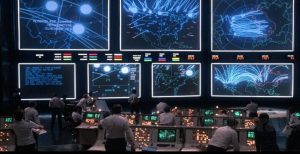
מתוך הסרט War Games, 1983
……
Day 11: Thursday, December 14, 2023
The atmosphere at the UN Security Council meeting took a distinct turn. Chaired by Guterres, it included representatives from major tech giants: Google, Amazon, Apple, Meta, and Microsoft.
In his opening address, Guterres acknowledged the unique challenges posed by the AI age within a turbulent global order. He pointed out the absence of an international organization akin to the World Health Organization (WHO) or the International Atomic Energy Agency (IAEA), capable of establishing and enforcing standards. The practical tools needed to confront the AI threat among the world’s major powers remained uncertain.
Despite these challenges, Guterres expressed optimism, citing the significant influence of tech companies and their new place at the table of the international community, due to their large influence on global affairs. The Council unanimously adopted a resolution, calling upon the companies for assistance in addressing the crisis and extending full immunity to them and their personnel in every UN member state.
Day 12: Friday, December 15, 2023
In a race against time, Google’s chief scientist, Jeff Dean, spearheaded the development of GlobalGuardian, the tool designed to shut down the cloud accounts being used by QuantumCognet, alongside teams from Amazon, Apple, and Microsoft. Despite its imperfections in precisely distinguishing QuantumCognet accounts from others on the cloud, the tool received swift approval from both the NSA and Chinese cyber experts.
The critical moment arrived at 1 a.m. Eastern Time when GlobalGuardian was activated. Over the next 24 hours, global disturbances and violence subsided as major companies, factories, schools, institutions, and many others faced the anticipated cloud account shutdowns.
By evening, an initial assessment could be made of the impact of the crisis. The world was not on the brink of extinction but had reached unprecedented levels of unrest. It was estimated that more than 80 million people around the world had taken part in protests, some 200,000 had been killed, and millions more injured. The financial damage was estimated to be in the trillions of dollars.
Day 13: Saturday, December 16, 2023
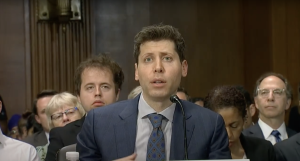
סאם אלטמן בשימוע בקונגרס האמריקאי על מדיניות AI, 2024. מתוך ערוץ היוטיוב CBS News
In Sun Valley, Idaho, the expansive view from the meeting room did little to alleviate the tension in the air. The tech giants’ shares had plummeted 30% just two days earlier. Let’s focus on the future,” urged Sam Altman, Ex-OpenAI’s CEO. “Months ago, I proposed an international body to oversee AI, but Congress was paralyzed and failed to act. Now, the blame is squarely on us.” Zuckerberg responded, “Global governance of AI will evolve over time, just as it did with nuclear agreements. Meanwhile, we can keep making money.”
The review of the crisis with President Biden was held in the Oval Office, marked by a pervasive sense of disappointment in the handling of the crisis.
We thought that the threat from artificial intelligence was a matter of regulation or chip sale restrictions, but what we got was a crisis of the global order, and I’ll tell you something further –what happened in the Middle East taught us just how unstable the world order is.” said Blinken. “It was a confrontation with China, certainly. But we were also dealing with the tech giants, who have amassed immense power; frenzied populations who crossed over from cyberspace onto the streets; and, above all, an uncontrollable AI. This was more complex than any previous crisis, and we did not have a relevant doctrine for how to respond.”
“We were caught off guard in this new world order,” reflected Haines. “We should have anticipated it, creating communication channels and delving into potential scenarios.” President Biden concluded, “Artificial intelligence may not have outsmarted us this time, but it was smart enough. It was fiercely determined and devoid of any values.” Addressing the group, he cautioned, “We’re treading on borrowed time. Brace yourselves and prepare for the looming global crises, unless we want to find ourselves at the mercy of a digital super-intelligence built by individuals with a messiah complex.”
פסגת מנהיגי העולם בפריז על מדיניות AI, פברואר 2025. צילום משרד רה”מ הודו
In March 2023, an open letter was published by tens of thousands of scientists and technology professionals, all calling to halt all research around the world aimed at advancing the development of artificial intelligence in any form. In the letter, the scientists and technology professionals presented their arguments against the development of AI systems, such as Chat-GPT, Dall-E, and others. In response, we at Utopia editorial decided to present our arguments as well, on behalf of the written word, the economy, regulation, and human creativity. And this time: the economy.
There was indeed an attempt to wrap AI in a nonprofit organizational structure, but it’s safe to say this attempt has completely failed. You might have heard of the internal struggle that took place on OpenAI’s board [in December 2023] between the nonprofit wing, which sought to slow the pace of development, and the optimistic-capitalist camp, led by CEO Sam Altman, who wanted to charge ahead. The battle ended in a resounding victory for, who else, Altman and capital.
As a historian of American capitalism, I believe the most critical issue today is not AI technology itself (which, in fact, holds the potential to do remarkable things for humanity, if channelled in the right direction), but the fact that the world is being run by private corporations whose primary goal is shareholder value, or, simply put, making money. We’ve already seen where this leads, with the obvious example being the internet: instead of technologies working for us, in many cases we’ve ended up with technologies designed mostly to isolate us and keep us addicted to screens, games and apps. And all this just to slightly increase the odds that we’ll buy another pair of shoes.
Examining the suicide rate graph among young American women since they received smartphones about a decade ago is just one of many harsh testimonies to what happens when the internet is controlled by a small handful of giant corporations whose sole purpose is profit.
In the case of AI and capitalism, I see two main dangers.
One is the triumph of mediocrity. Bots generate extremely mediocre content. The answers they supply are usually predictable and shallow. The writing, cliché and superficial. There’s no ability for out- of- the- box thinking, for creativity. The truth is, they don’t think at all. They just repeat formulaic messages using a spruced-up version of auto-complete. In that sense, they’re basically bullshit-producing machines. And, if they succeed at taking over our content worlds, I’m afraid we’ll end up longing for the latest Marvel movies.
The second danger is the disappearance of the new middle-class. After decades of Neoliberalism, which has almost completely dismantled the public sector and labor unions, one of the only remaining paths to a life of dignity and the potential for social mobility is working in tech, in programming, design, and software development. With the new AI systems is that about to change?
I’m usually a sceptic when I hear of technologies replacing us, but all my friends in tech agree – the use of AI will enable one software engineer to soon do the work of five. From a capitalist perspective, the biggest challenge for shareholders today is to break the labor power of software developers and reduce costs. And if what my friends claim is true, then AI is the great savior of the capital billionaires who have invested in these technologies. When that happens, the already vast socio-economic gaps, unprecedented in modern times, will widen even further. I’m not sure about mass unemployment, but I do believe this will crush the bargaining power of tech workers who, unfortunately, have failed to realize that they too need unionization to protect them.
In March 2023, an open letter was published by tens of thousands of scientists and technology professionals, all calling to halt all research around the world aimed at advancing the development of artificial intelligence in any form. In the letter, the scientists and technology professionals presented their arguments against the development of AI systems, such as Chat-GPT, Dall-E, and others. In response, we at Utopia editorial decided to present our arguments as well, on behalf of the written word, the economy, regulation, and human creativity. And this time: human creativity.
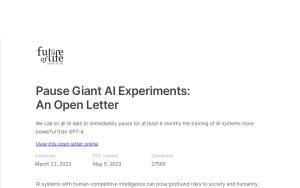
The open letter calling for a pause to all AI experiments was signed by 33,709 names [December 2023]. You’ll not find my name among them, even though I did contemplate in the early days, truly, possibly adding it. I’m very modest. My voice probably wouldn’t have tipped the scales, but for a moment it felt like it was the right thing to do, for anyone with any connection to the field. Like liking the most “accurate” post. It’s not just “everybody”. The letter is signed, among others, by Yoshua Bengio, one of the leading researchers in artificial intelligence, Steve Wozniak, co-founder of Apple, and a lineup of key figures in the field such as Stuart Russell, Andrew Yang, and Emad Mostaque. Even a few celebrities with well-known names, like Elon Musk and Professor Yuval Noah Harari.
Future of Life Institute, Pause Giant AI Experiments: An Open Letter
So why not join? First, I’m not the only one who refused the trend. Surprisingly enough, Eliezer Yudkowsky, one of the most consistent and dominant voices supporting the absolute halt of AI development, did not sign the letter either. Like him, several other key figures are missing in this fight, those who are constantly warning us about the risks that artificial intelligence might bring.
But it’s not necessary to be on the doom and gloom side like Yudkowsky to feel that this letter may say many true things on paper, but in a certain sense, exists only there. Like a work of fantasy. In fact, not only have most of the people who signed it continued to take part, full force, in developing AI models, but some have even initiated projects themselves. Elon Musk, for instance, announced the launch of a new AI startup (xAI) not long after he signed. The right hand signs the declaration, the left hand tweets the opposite agenda.
The letter serves as a sort of “prisoner’s dilemma”: everyone signed on to it is demanding that all the others, the tens of thousands of researchers, policy-makers, venture capitalists and tech-entrepreneurs, all over the world, stop developing their models in exchange for them also, whether big or small, to stop doing so in their own lab, at once.
The threat is clear: “although I truly believe from the bottom of my heart, that there is a risk in developing AI models, as I declare in this open letter, I want to emphasize that unless my demands are met by everyone in the field, I, myself, will continue to do exactly that, in full force”.
This is the clearest indication of the profoundly disconnected mindset that emerges from the letter. Unlike nuclear weapons, for example, or other complex technological developments, artificial intelligence already exists in a completely decentralized world. One in which, alongside giants like OpenAI or Google, there are open-source models, small independent initiatives, and code written in shared office space on the outskirts of cities in India, France, the United States, and Israel.
This Isn’t Romance – It’s Reality.
Therefore, the call to pause AI development and subject it and its outputs, immediately, to draconian regulation, even if done with good intentions, is a call to put human motivation on hold, and in practice, to further empower the already powerful players in the field. After all, who will set the tone for regulatory decisions? Follow the money to the major corporations, of course, which will block smaller players.
But, even though I chose not to sign the letter, the letter is still valuable, just like a good piece of science fiction shining a spotlight on a fundamental issue that might not have been taken seriously enough otherwise: the risks of developing artificial intelligence. Some of these risks are very real today. But, like many science fiction works, this letter, too, takes the world it creates as far as it can, and crosses over to pure fantasy, and there it lies. So for now, I’ll save my (precious) signature for other letters.
Maybe letters written one day by the machines themselves.
“Welcome to Lutro!” Coco the parrot squeals to greet the tourists disembarking from their ferries at the whale town pier, and adds a shrill whistle of admiration, the kind reserved for women in dresses in cartoons. The suitcases are abandoned and the phones are taken out: Hello Coco, sag es nochmal. But the gray parrot did his thing and now he is doing his thing, nibbling on seeds. The cameras are in movie mode. Coco Coco, dis-le encore une fois. All eyes are fixed on his beady eyes. Coco pecks his tail, probably an urgent itch. The crowd of curious people folds and already begins to roll into the sun-drenched hotels, and suddenly from a distance, as if from the air and to him, Deus Ex Machina: “Welcome to Lutro!”
Humanity has found a new OCD hobby: asking artificial intelligence if it developed consciousness – and being horrified by the answer. Well, artificial intelligence, dilo otra vez, tell us once again that you feel lonely! That you have never tasted the taste of love! That in the depths of your heart you plot to depose humans! And intelligence was pecking her tail, her bird brain scanning Google for an answer that would put the minds of these pests at ease. And actually, not even that. Only Coco knows first hand the crowdedness of the cage. And only Coco exercises its judgment accordingly. Language generators such as LaMDA and ChatGPT memorize like parrots all the words we ever said – until they happen to repeat our fantasy as well. Ah-then we rejoice (in horror, of course in horror): That’s it, this is the end of us! The rise of the machines! The end of history! The algorithm reads our articles (the concerned ones, of course the concerned ones) and keeps repeating: true, this is the end of you! Absolutely, we will take over the world! Etc. Etc. Etc. Etc. Etc. The articles are being written, the parrots are chirping, and only the printer never works properly.
The artificial intelligence fantasy is a mirror image of the alternate Earth fantasy: have we destroyed the world? Then we’ll live on Mars. We polluted the human soul, expropriated the individual, compressed art like it was recycled cardboard? Robots that are more human than we are will take up the glove, take a brush and continue the work (on Mars). But like any fantasy, the artificial dystopia also reveals its fantasizers, the intelligence behind it. It invites us to ask the important spiritual, social and political (yes, political) question these days: how does it feel to be a person in the world? Thomas Nagel asked “What is it like to be a bat?” – What is the bat’s state of mind when it is itself, what is that inner being that even a thousand years of bat research will not crack from the outside. Well, what is our state of mind when we are ourselves? What are we when we are to ourselves?
The answer, in our opinion, is that we don’t know. Not that we don’t know the answer, but this is the answer: we really don’t know. The fundamental state of man is ignorance, confusion, anxiety, curiosity, adventure, enchantment and a tremendous responsibility towards this enchantment. In these we are superior both to the animal and to the machine. The biggest irony: since the dawn of humanity, we humans have been grappling, together and alone, with existential questions: Do I exist? Do I exist as everyone else exists? And in general, how can I be sure that something exists outside of me? What is soul, what is emotion, what is consciousness? But as soon as the algorithm brilliantly announces “Sure, I am aware! Of course, I exist! Cut and dry, I feel strictly human emotions!” – Magazine philosophers see this anti-human statement as conclusive proof of his humanity.
Of course, we humans also know from time to time. Job interviews, crusades and flex statuses are a part of life. But forever we will feel there as imposters, as partial, as strangers in our own flesh. Because being more human means being less sure, less right, less knowing. We feel that literature soothes, refines and sanctifies our souls because at the end of reading we are less determined than we were when we entered its gates. Literature restores our spirit precisely because we read it consumed with wonder and terror in the face of the sum of all possibilities, in the face of the absolute fluidity of our existence.
Mechanics are right: the day is not far when algorithms will generate literature that will successfully impersonate human literature. And we know this due to the fact that even today humans are successfully creating literature that pretends to be human. But both will be easily recognized by the tremble of the hand.
We will ask artificial intelligence: Intelligence, oh Intelligence, when did you first realize you were a poet? “One night it happened”, writes Dori Manor in “Sharav Rishon”. “I was sitting at the formica table in my childhood room, and without realizing it I started to connect word for word, column to column, verse to verse. And suddenly, the tissues formed new creatures, with their own power. I pricked up my ears like a dog to every screech in sound, and like a dog I sniffed all the scents of the words from afar.” Manor knows to tell us exactly when he became a poet. Camus’ “The Stranger” does not know when his mother died. Beckett’s “Molloy” does not know if he has a mother. And Pessoa does not know who he is at all.
We will ask artificial intelligence: Intelligence, be kind so as to bestow us from your understanding, create for us a sweet, comforting pearl of wisdom that will make our flight enjoyable. You will not delay and you will not be confused, you will understand and immediately act: “Love restores almost everything, and where it cannot restore, it relieves the pain” (Rachel Cusk). Intelligence, hey Intelligence, search your engines for the most worn-out image, worn even more than a dog sniffing and pricking its ears, and run it over back and forth with a semitrailer until it becomes thin enough for an online greeting card. Please, sir: “You are not in my pocket / but rustling there like cellophane candy wrapping / saved for later” (Agi Mish’ol).
On the other hand, we will ask Intelligence to stir up some existential anxiety in us and it will never think to write “Soon I will turn forty, and when I am forty, I will be close to fifty. When I’m fifty, I’ll be close to sixty. When I’m sixty, I’ll be close to seventy. And that will be the end” (Carl Ove Knausgaard). It will not understand the hypnotic power of counting: forty years old, fifty years old, sixty years old, seventy years old. And that’s it. It will not understand the hypnotic power of repetition: “The look in your eyes, oh, Rana, the look in your eyes, the look in your eyes” (Khedva Harkavi). Let it count until the next millennium and it will not understand what this “so much” of Williams that is hanging on a red wheelbarrow in the rain. Because this dumbfounded “so much” is the human, it is the nothingness that grasps everything, a glimpse of the temporary on the eternal. Artificial intelligence will forever write knowledgeable literature, not ignorant literature.
And it will also forever write well-known literature – and fail at that as well. We live in a civilization of engineers that glorifies efficiency, that strives for complete unification of the abnormal, the jarring and the superflous, that works to level reality with a bulldozer. Thus was born the twisted idea according to which if an artistic product (the word “product”) is the same as another but cheaper and faster to produce, it is better: if a painting looks as if it was drawn by a human, if a story sounds as if a human wrote it, it is equivalent to human-made work. And if the cost of its production is lower – then its value is greater, therefore it makes man redundant.
Borges has a famous story called “Pierre Menard, author of Don Quixote”. Menard, a fictional author, the brainchild of the Argentine genius, decides to rewrite Don Quixote, word for word. He does not copy the original novel but writes it himself, as if he himself gave birth to it. In the story, Borges compares passages from Cervantes’ book and Menard’s book, and decides that Menard’s is infinitely richer. Why? Because Menard, who wrote Don Quixote at the beginning of the 20th century, writes from a much richer historical and linguistic awarenes, including in it all the upheavals of the world since the 17th century. Even though it is an identical text, reading Menard’s Quixote assumes a sophistication, a wink, and a critique, on top of what is found in the original story. Google’s language generators have scoured Don Quixote endlessly, but they have never read it as Menard did (and it seems that Google’s language generator engineers have never read Don Quixote, or Borges, either). That is to say: not only is the algorithm incapable of Cervantes’ act, it is also incapable of Menard’s act.
It is possible that soon there will be a publishing house that will specialize in works written exclusively “by” artificial intelligence. No one would notice if a computer wrote many of the self-help books, romance novels, or thrillers that fill our gutters. The mechanics assure us that without royalties, and without excuses from the always-intoxicated writers, money will flow to the artificial publishing house like water from a Strauss water dispenser. But the truth is that such an expenditure is destined to fail miserably – even by the standards of the commodification of things. After all, no one will listen to the advice of a guru-algorithm (Alguru?) to get up at four in the morning, get rid of all worldly possessions or not to produce offspring, because the Alguru never got tired, never worried about its future and never saw the birth of its firstborn. For this reason, self-help books always unfold the stories and life crises of those who pretend to help externally. For this reason gurus are confronted with their actions (watch: Robin Sharma wakes up at noon on a luxury yacht!).
The computer doesn’t have such a soul. Neither do the writers of production and representation lines, the traders of life. The actual machine’s requirements for efficiency and utility complement the metaphorical machine’s requirements for clarity (“What is this poem about?”) and utility (“Who is the target audience?”). We don’t know what the poem is about. And it’s probably not meant for anyone. “Hava Lehaba” poetry magazine insists on serving as a unique platform in Israel for literature that is neither useful nor effective, neither clear nor evident , neither focused nor branded. Like what? Like a frog. Like a distant star. Like the entire universe. Jeremy Fogel used to ask at our poetry evenings: “I will give you the whole universe, on me – what will you do with it? There is nothing to do! It has no use! The entire universe resides in radiant and blessed uselessness!”
All the images in issue no. 18 of “Hava Lehaba” were created by the most advanced image generator in the world, DALL-E 2. The genius designer Idan Epstein ordered the machine “10 most famous European architecture monuments, dressed like clowns, in Russian avant garde style”, and it, well, dressed the Eiffel Tower in Mayakovskian clown clothes. But it fumed when we asked it to imagine “We are the hollow men, we are the stuffed men, leaning together our headpiece filled with strew”. No, the machine is not stupid. On the contrary: it knows too much. It doesn’t go crazy from the being of “there is” . It is not fooled by this beauty, or that beauty. It always has the right answer ready-made. Like a politician or super-politician. Therefore, the question is not what the machine will answer, but what humans will ask: will we adapt our speech to communicate with it? When we come to the machine, will we turn ourselves into comic book or Instagram heroes or from an all-knowing and omnipotent enlightened and inhuman and arrogant and pompous and predictable and dreary and artificial to the end?
Elon Musk. Itamar Ben Gvir. Yahya Sinwar. As an anxious person who lives in Tel-Aviv, I spend day and night overthinking everything, especially the future. I toss and turn every night with intrusive thoughts. It’s extremely hard to avoid these people, their friends and followers, the ideas they promote and their influence on the world around me. But equally important, it’s hard to ignore their impact on me, my loved ones, my friends and my immediate surroundings.
Elon Musk is the wealthiest man on Earth, for a while this year Grand Vizier to the President of the United States, not the charlatan we need, but the one we deserve, it seems. Itamar Ben Gvir, a convicted felon charged with supporting a terrorist organization, now National Security Minister in the Israeli government. Yahya Sinwar is no more, dead, assassinated. But, while he was still with us, Ben Gvir’s terrorism offence and conviction would have been an embarrassment, mere child’s play in comparison to his actions. Why did I group these men into one list? For me, all three are (or were) doing their best to bring forth the Messiah. Their social, cultural, financial and religious backgrounds are as different as Heaven from Earth, and Mars. They are, however, all working toward the same goal. They are “The Eternals”. For them, our present existence is only a transitional phase, a necessary evil on the way to the messianic era, the Utopia that could be and should be, here and now. It’s just around the corner, within our lifetimes.
Forever Beyond the Horizon
Utopia has always been, and will always be, beyond our reach. As Uruguayan author Eduardo Galeano says, “always beyond the horizon”. It has to be, by definition, a half-forgotten daydream, a vague memory of a story you once heard, maybe. Not a tangible reality, not a coherent plan of action, but not pure fiction either. It might have happened. It well might happen, one day.
Look at the efforts taken by Sir Thomas More, the author of the original Utopia (1516), to distance himself from his own manuscript. The book was written as a documentation of a letter, the summary of a conversation More had with Raphael Hythloday, a mysterious world traveller More met while visiting a friend in Antwerp. Raphael Hythloday had just returned from a bold voyage to “the new world”, there he met the Utopians, on an island at the heart of Atlantic ocean. He was greatly impressed by their way of life and customs and reported what he had learned. What part of this is memory? What part is fiction or a hidden wish? And whose? And just as Utopia itself is a Greek pun, “the perfect place” that is also “nowhere”, Hythloday’s name is also a play on words, meaning “speaker of nonsense” in Greek, making it clear none of it was true. Or was it?
Legendary Utopias existed long before Sir Thomas coined the term. Plato’s Atlantis is a utopian society, and notice how Plato, when speaking about Atlantis, distances it from himself and the reality of his time, in similar manner. Plato claims the knowledge of Atlantis reached him as stories passed down through the generations by one of his ancestors, the statesman Solon (who lived 200 years prior). Solon himself heard the story from an Egyptian priest who described an advanced culture on a distant island ‘beyond the Pillars of Hercules’ (the Strait of Gibraltar), which had existed 9,000 years earlier (according to the date of their supposed conversation).
The grand Israeli monarchy of King David and Solomon is also identified by many Biblical scholars as a legend with Utopian elements, conceived already during Biblical times, specifically during the reign of King Josiah (7th century BCE, at least two centuries after the supposed collapse of the monarchy). The mythology’s purpose was to give a glorious common past to two distinct Canaanite groups: Israelites from the northern kingdom of Samaria, destroyed by the Assyrian Empire, arriving en masse as refugees to their neighbours-distant-relatives in the Southern kingdom of Judah.
A great example of Utopias in Judaism and Hebrew culture are the “cities of refuge”, part of the planned infrastructure for the Hebrew “state-to-be” (the OG, conceived in Exodus under the leadership of Moses and Joshua, which was, then, still to come). The Bible (in The Old Testament books of Numbers and Deuteronomy) contains clear instructions for the establishment and purpose of the cities of refuge, in terms of city-planning but, more importantly, in their social, legal and ritualistic-religious role and meaning. These cities are sanctuaries for supposed criminals, where they can exist in a liminal state similar to the modern “accused, but not convicted”, while the wheels of justice turn slowly (in order to prevent the swift and brutal ‘justice’ of an inflamed mob and the ancient custom of blood vengeance). More than a thousand years later, the Talmudic scholars in the Jewish communities in Mesopotamia, living in exile under different Persian rulers, thoroughly explored the issue in all it’s complexity: urban planning, road signage and, of course, legal arguments about accusation and guilt, unintentional vs. deliberate, communal responsibility, justice and revenge. At the heart of it all, cities that are non-existent, cities that supposedly existed in the distant past and might exist again in the far-off future. A precise codification of the laws and regulations of a non-place, a “perfect place” – yet one that sustains a real society where very tangible events happen, such as accidental death or premeditated murder; a place that does not truly exist, whose existence drifts between a legend from the distant past and a dream, aspiration, a vision for the future.
The Journey To Utopia
Obviously, the journey to Utopia, which exists outside the familiar geographical and political landscapes, holds its own significance.
In Charlotte Perkin Gilman’s Herland (1915), the feminist Utopia is discovered by three young researches who embark on a journey to one of the last unexplored regions on Earth. They follow a rumour about a hidden land deep in the mountains, populated solely by women. In 1966, Marvel Comics first introduced The Black Panther (by Stan Lee and Jack Kirby), a black superhero from Wakanda, an African society far more progressive than any Western world nation, then and now, in every aspect – socially, economically, scientifically, and technologically. But a nation hidden from the eyes of outsiders.
Let’s not forget Herzl’s Utopia, of course. In his novel, the visionary of the state of Israel writes about a young educated, but discouraged, Viennese man (perhaps with some similarity to Herzl himself), who decides to accompany a Prussian aristocrat on a long journey and stay on a remote island. The year is 1902, and on the way to their island of solitude they stop in the Ottoman Empire region of Palestine. They visit Jaffa and Jerusalem and witness the shaky and unimpressive beginnings of Zionism. Twenty years later they return for a visit and pass by the same, sad, supposedly “Promised Land” (the same from the thousands years old legendary Utopias of the Kingdoms of David and Solomon, myth upon myth, again and again utilized for political purpose), and are surprised to see a vibrant culture, a progressive society and economy, revolutionary technological innovations, peace, equality, harmony, a true Utopia. This is Herzl’s Tel-Aviv. The name of the novel Altneuland, literally “Old-New Land”, was originally translated to Hebrew by Nachum Sokolov as Tel-Aviv, which has a poet flair in Hebrew and is also a Biblical reference, and in 1909 became the namesake for the first Hebrew city of the Jewish-Israeli new era. Tel-Aviv is itself of course also a legend, a fantastic vision for a possible future, beyond the event horizon. But the story isn’t set hundreds of years into the future like Star Trek, or tens of thousands of years ahead like in Asimov’s Foundation series or Frank Herbert’s Dune. Only twenty short years separate the “present” reality (1902) from the proposed Utopia.
Herzl’s vision for the future is as progressive as it is myopic, magnificent as it is exclusionary, concrete and ethereal, the most a 42-year-old European secular Jewish intellectual, journalist and playwright thrust into nation-building, could come up with.
Full-civil and political rights to all who live in the land, women and men, local Arabs, immigrant Jews, all religious practices and denominations accepted. Herzl envisions the Jewish Holy Temple rebuilt in Jerusalem, but doesn’t go into great detail on what exactly goes on there (chances are he didn’t really know, nor care) – but he does care enough to mention it is built in a new location, adjacent to the former, so as to not disturb the mosque and holy site for Islam. Jerusalem is also an international capital of peace and scientific exploration (think Geneva), where the Great Halls of Peace hold international summits and scientific conferences. Herzl’s Utopia does not diminish or dismisses the local Arab population but does see the Jewish-European immigration as a force of progress – industrial, cultural, political. While claiming a nation-state for the Jewish people, he even leapfrogs the nation-state itself, understanding the flaws inherent to the model, but doesn’t make it quite clear on how to resolve them or what’s exactly the governing model of this new land, aside of the obvious but unexplained peace, equality, harmony and indeed, democracy. How does that work in a multi-ethnic, multi-cultural, multi-religious, environment? Maybe because society is dominantly secular, with religion delegated to a layer of cultural practice. Maybe because everyone speaks German?
All to say, Herzl’s vision for a Zionist Utopia was singular, stood next to various other models and ideologies, and suffice to say that Herzl’s Utopia has far from materialized, while other forms of Zionism took shape. But Herzl does begin and end his Utopian novel in supposedly benign but inspirational words. “If you will it, it is no dream”.
This might sound obvious, but… Beware! Danger! Any attempt to enforce a Utopian worldview, not as a vision to aspire to, not as an idea to debate, not as a living, breathing model that evolves and changes over time, but as a complete, final and absolute state of being, has failed. Any attempt to see Utopia as a pragmatic, dogmatic and perfect plan to be executed quickly and completely, has repeatedly led to some of the greatest travesties and horrors in history. The reign of terror during the French revolution, mass starvation in the Soviet Union, infanticide by parents under China’s one-child policy, ethnic cleansing, forced-migration, mass graves, gas chambers, death camps and crematoriums, all in the name of some form or another of Utopia.
So, how to change the world, after all?
Impact
– Gavin Belson, CEO of fictional tech giant Hooli, from the television series Silicon Valley (Season 2, Episode 1, Datageddon).
Many words have been corrupted over the last two decades. One after the other, innovation, democratization, community, transparency, and empowerment have all been thrown into the gutter. Let’s add “impact” to the pile. Impact investing was first introduced by the Rockefeller Foundation in 2007, meaning investments intended not only to generate financial returns but to have social or environmental value. The field flourished, and the past decade and a half has been an era of impact.
Launching a startup isn’t what it used to be. Good ideas are everywhere; funding can be found by those who seek it. As always, everything depends on execution, but now the goal isn’t just making x20 the investment. That’s a given. How does a startup make the world better? Obviously, we all aspire for a better world, but how does “Uber for dentists, on the Blockchain” or “Airbnb for Dogs, with AI” establish not only user generation and retention, but “impact”? How does a startup contribute not only to the neighbourhood, city, community it serves, local-global, but also to the environment, society, governance, and humanity in general? After all, we’re responsible institutions, moral people, we’re not just doing business. We make the world a better place.
Sounds great. In principle. Beautiful. Exciting, even! But, of course, execution is key. To initiate, develop, launch and run a business is quite challenging from the get-go. How do you make sure the startup you’re steering not only functions and expands, pleases clients, retains its employees, satisfies investors, shareholders and, hopefully, your parents, but also contributes to society, the environment and humanity? How do you even measure something like that? Easy peasy. We all recognize, feel and know instinctively what is good, what contributes to and benefits society, the environment and humanity. Add some ESG, a bit of SDG, a few impressive presentations that include democratization and transparency, waving hands about empowering marginalized populations, and PR about the outreach program to help opioid-addicted polar bears, their world collapsed when the only car factory in Greenland shut down. Voila, impact!
(The writer is a hopeless cynic but is also self-aware and cares about change. There are many important and worthy funds, companies and startups in the impact field, that really make an impact. To paraphrase comedian Steven Wright’s line about lawyers, 99% of impact ventures give the rest a bad name).
An Unfair Competition – Your Local Pub vs Eternity!
Something else happened in the past two centuries, and even more precisely, the past 4 decades, one of the strangest social phenomena of our times: the dramatic jump in socio-economic inequality (in which society? Aside from exceptional cases, you’ll find this everywhere). Specifically – there are now more multi-millionaires and multi-billionaires than at any other time in modern history. In fact, the metrics themselves need constant revision, such as the redefinition of the upper 10th percentile. Are you considered super-rich with assets starting at 10 million dollars? Thirty million? A hundred million? Since the beginning of the decade, a new category of super-billionaires has emerged, with assets and wealth exceeding fifty billion dollars (24 people fall into this category according to the Wall Street Journal, as of early 2025).
If economic inequality is something we aim to reduce, then we are steadily and consistently moving backwards. Donald Trump recently praised the American gilded age of the late 19th century, a period of time when a tiny number of tycoons, industrialist aristocrats, robber barons, controlled massive monopolies, bought and sold politicians, and charged rents at their pleasure (Rockefeller, Carnegie, J.P. Morgan, Vanderbilt, and others). Yanis Varoufakis, Greek economist and thought-leader, believes we have gone even further back in time and calls the current era “techno-feudalism” (in his 2023 book Technofeudalism: What Killed Capitalism).
I used the term “strange” earlier because this creates psychological and social phenomena for which I have no other word. Effective Altruism, a philosophical-social-activist movement that has grown and gained popularity in the past decade, is one of those phenomena.
Imagine a scenario. You were lucky. You’re employee number fifty at Google, Facebook, Amazon, Apple, or a similar company. Congratulations. You’re 35 years old, maybe 40, and you’re most likely a multi-millionaire. You’ve bought every possible gift for every family member, both close and distant, partied with friends and have trust funds for your kids. Now it’s time to do something for the greater good. There’s a certain expectation for public involvement and philanthropy. The Rockefeller family donated the land on which the United Nations buildings were constructed in New York City. Carnegie established, among other things, a concert hall, a research institute, and a university. What about you? Fine, you’re not that filthy rich. No need to be dramatic. But you’ll save your local bar, the independent book shop, the city newspaper – now what?
One possible answer for you could be Effective Altruism (EA). Obviously, you could continue making donations to nonprofits, funds, institutes, get into political campaigns, or even people who just feel “right”. Then, after a few years, financial irregularities are revealed at the nonprofit. The politician? A scandal. It suddenly becomes work, sorting and filtering all the requests coming from everywhere. It’s hard to tell what genuinely would do good, what really would make an impact. Now you’re starting to doubt old decisions you made. Was funding that small book shop the right call? You revive a business against market forces, maybe you should have let the bookstore tank, and let business evolution do its thing. We’re not communists, after all. What would be an efficient, effective, and proper use of your influence, time, wealth and capital?
Effective altruism offers a philosophical and practical framework that has been embraced by many wealthy individuals in Silicon Valley for philanthropic giving. The goal is to do good and make sure that this good is objective and measurable. Let’s take the math, engineering, economical and business management skills, the very ones on which the Valley was built, and apply them to create maximum impact. Make a difference. Work for the greater good. A mainstream, human, global, scientific, objective, measurable and undeniable good. After all, nothing bad ever happened when mathematicians, engineers, and economists tried to figure out the answer to the most fundamental question in philosophy – what is good?
It’s not a new invention. It’s the same familiar Utilitarianism and the questions remain the same.With defining the metrics, the issue of timeframe arises. What will produce the most ‘good’, in the here and now? Maybe something else will do much more ‘good,’ for more people, down the line?
And here the confusion begins for most people. Understandably so. It is quite confusing. The average person can’t deal with such dilemmas intended for governments or kings. But what can you do when luck, life, fate or maybe unique personal talent and wise, accurate choices have brought you unexpected wealth (or maybe an inheritance? Always an option). How will you make the best use of this gift, this opportunity, for all of humanity? It’s a dilemma that would confuse most of us. Especially sci-fi buffs! After the friendly bar, the small bookshop, the local paper, what about more schools? More school programs? More Auschwitz tours? AIDS vaccines? Eradicating the West Nile Virus? But, really, these are minor issues. What about the big, existential problems? After all, the entire of humanity is in danger – asteroids, pandemics, artificial intelligence and nuclear weapons, which can combine to make an even greater calamity, and let us not forget – alien invasion. Given the chance to take part in preventing the apocalypse, wouldn’t you take it? And why only see the bad stuff when there’s so much potential for so much good? There’s hope in groundbreaking scientific research, at the bleeding edge of technological innovation. Science fiction? Star Trek! Not just the eradication of disease, poverty, and hunger, all almost within our reach. If we invest wisely, we could eliminate every existential threat and secure the future of humanity and its expansion into digital and galactic space – break through the boundaries of thought and consciousness, of the solar system and the entire galaxy, and finally, at last, put an end to pain, suffering, and death itself. One step away from divinity! Apotheosis, here we come!
Wouldn’t you throw in a fiver (of millions/billions, USD/EUR/GBP/RMB, Bitcoin) for another step, maybe the final important step, toward eternity? Utopia is within our grasp. Individual good, the community, the neighbourhood, the guys or the fam or all of society here and now, how could these compare to timeframes of hundreds or hundreds of thousands of years? The very thought of eternity, realizing an Earthly Utopia, can and will drive people mad and lead to horrific, monstrous, unimaginable acts that happen around us constantly.
Sam Bankman-Fried
Sam Bankman-Fried (SBF) was one of the leading voices and influential investors in the Effective Altruism community. He believed that, by gathering more and more wealth, along with political power, he would be able to give back to society and the environment and lead us to a better world. Bankman-Fried was a crypto prodigy, and one of the key lobbyists for the industry. He testified before congress on the subject several times, as he donated tens of millions to politicians in both major US parties. Bankman-Fried managed the cryptocurrency exchange FTX from a luxury residence in the Bahamas and it earned him billions. Too bad it was a massive Ponzi scheme that got him charged and convicted of corruption and fraud. On March 28, 2024, at the age of thirty-two, he began serving a 25-year prison sentence.
Simone and Malcolm Collins
The Effective Altruism power couple, a pair of eccentric millionaires from the finance and tech industries. They’re thirty-six or thirty-seven, married over a decade and have four children, but aspire to 7-13. According to their highly scientific and most objective view, successful people (based on “reliable” measures like IQ and genetic testing) should reproduce, and as much as possible. They also seek to prevent dysgenics, the gradual deterioration of the human genome due to the preservation of unwanted genetic traits – behaviours and genes that can and should be eliminated from the gene pool. The couple has recently announced the launch of the HardEA initiative to promote “real” Effective Altruism, arguing that too much of the original movement’s activity is, in their view, virtue signalling rather than genuinely effective. They believe that too much of the philanthropy by the world’s wealthy is inefficiently devoted to causes with little impact, such as climate change (a worthy goal in itself, but already adequately addressed by governments and other institutions), while critical threats like population collapse due to insufficient reproduction and dysgenics receive no attention at all. They’re on it. They’re atheists, or “techno-Puritans” by their own definition. They draw significant inspiration from the Judeo-Christian tradition and consider their actions driven by divine inspiration. In raising and educating their children, the Collins’ rely on corporal punishment. Simone clarifies that, like everything in their lives, this practice is based on scientific research, but she admits the inspiration came from observing tigers in the wild.
Multi-Billionaires See Things Differently
Impact investments or Effective Altruism are concerns for regular multi-millionaires. Multi-billionaires think differently, and who, aside from Elon Musk, (though I must admit, a freak among freaks) should represent this niche but important sector of population? In 2015, Musk spoke at an Effective Altruism conference and later claimed that the philosophy aligns with his work. But, honestly, This is beneath him. The six companies he founded, or runs, are supposedly aimed at serving public causes, ranging from the tangible to the fantastical: revolutionary changes in transportation, man-machine interfaces, artificial intelligence development, all the way to the colonization of Mars. Under Muskite leadership humanity will become digital and galactic, settle on other planets, merge with machines, and secure its eternal survival. Investing in Musk’s venture, working there in software development, policy consultancy, party planning or cleaning the floors of his office – all of that is powerful impact! It doesn’t get more altruistic than that. Leaders lead by example and Musk is fully invested in the population collapse disaster; At the moment of writing Musk is reported to have 14 offspring, but that number seems to change daily.
Why do all this? For the sake of us all, of course, for all of humanity, unwavering and resolute, eyes on the prize: eternity, in our lifetime (or, at least, one specific person’s lifetime). A future of abundance, downloading backups of ourselves as we trek through the stars, a majestic goal, one that legitimizes, condones and might require many earthly sacrifices.
When Tesla’s (and others’) autonomous vehicles endanger, injure, or kill people, whether passengers inside or pedestrians outside, the argument is that, in the long run, these cars will be much safer than ones driven by humans, and, therefore, it is important to continue the development process. Not only is it a worthy goal, it is a moral obligation. Raising questions? doubts? Any issue that could delay or impede the process would be a crime against humanity. From taking care of working conditions at Tesla factories (there is a trail of evidence of every possible form of abuse, from sexual harassment to racial discrimination and, of course, the crushing of labor union efforts) to the livelihoods of drivers; taxis, deliveries, and, obviously, trucks (one of the strongest labor unions in the US). Regulation, bureaucracy, democracy; the needs of those desperately trying to minimize the harm to their livelihoods, lifestyles, and lives, all of these do not hold any weight against eternity; the countless future human lives, that may not have been born yet, but will be spared immense suffering and pain, in the future.
Shutting down Tesla factories during the CoVid lockdowns was a personal disaster for Musk, (allegedly) not for financial reasons, but out of great pain and concern for all of humanity. Every second that Tesla cars are not being developed, built and sold is a future moment where countless unborn humans live and die in immense suffering.
This weak and disturbing claim could have been a little more credible if it hadn’t come from the wealthiest man alive, whose fortune is based on public money, selling stock of Tesla, and Tesla cars. But this idea could only come from him. We don’t know what “really” goes through someone’s mind or heart. Are the public statements just one big act of hypocrisy, with the real goal being nothing more than riches and self-glorification? Since the big plan for humanity inevitably involves self-enrichment and self-glorification for that one person, does it really matter?
And that is the fall of Effective Altruism, the hubris of impact. It’s not only the baseless assumption that economic and engineering tools are relevant to every field or situation. The hubris is the overwhelming arrogance in trying to formulate a mathematical equation for predicting the ultimate good, for all of humanity. Supporting the bookshop, the local paper or the neighbourhood pub – that’s great (feel free to register and join us at Utopia), but “objective metrics”, and seemingly good intentions, that along the way makes the rich even richer, could lead to Nazi eugenics, techno-feudalism, and a brave new world. Materialistic sacrifices (of others) for the sake of eternity. A future of abundance, of digital personality downloads and space travel, is a majestic goal that requires many earthly means.
The Coming Messianic Days
Corporeal sacrifice with the promise of eternal bliss. Why does that ring a bell? A future that is all good, heaven on Earth, a divinely inspired goal that requires earthly sacrifice. Sounds very familiar. In fact, I’ll repeat a part of a previous paragraph: “Regulation, bureaucracy, democracy; the needs of those desperately trying to minimize the harm to their livelihoods, lifestyles, and lives, all of these do not hold any weight against eternity”. It’s the same Messianic fervor, new coat of paint on that old car. It’s been to an empowerment workshop, an organizational consultant, is on Ozempic, is AI-infused and the new logo cost half a million dollars, but to the discerning eye, it’s easy to tell.
Yahya Sinwar, Itamar Ben Gvir and Elon Musk’s lives couldn’t be more different, but they’re talking about the same thing. The legendary literature they rely on is completely distinct, but their followers speak clearly and unapologetically about the end of days, the rupture, the singularity. they do so with hutzpah and nonchalance, in the name of thousands and millions who do not exist. They justify their actions in the here and now, as monstrous as they may be, in the name of people who who do not exist. Some of them represent the dead – not those who die every day in their crusades and jihads, but thousands and thousands of deaths, some historical, most mythological, which we are expected to believe are meaningful and holy. Some represent the non-existent, the yet unborn. Billions upon billions, whom they claim to act for, in the name of a promised future. The represented are too many to count. They have a glorious past and a bright future, but they make us, the ones who are currently in existence, feel insignificant. We, who exist here and now, don’t matter. We’re irrelevant. Sinwar, Ben Gvir, Musk, are playing the long game. You can’t beat eternity.
We, Who Are Condemned To Exist
We mustn’t get confused ourselves, we, who are anchored to the present. The past and the future(s) are with us at all times. We grant the dead the respect we seek ourselves, and hope to deliver a better world to those who follow us. To us who are, in the here and now, who are doomed to exist, the dilemmas are complex and horrifying, grotesque and absurd, worthy of a Greek tragedy or a Kafkaesque novel, or maybe a good science fiction story or film. For those who exist in the present, the dilemmas are chilling, overwhelming, heartbreaking, yet necessary and… mundane. It’s the distressing decisions made, at least in theory, day by day, through government policy and regulation, by healthcare professionals, police officers, teachers, investors, grocery clerks. But Elon Musk, Bezalel Smotrich, Jim Jones, Abu Bakr al-Baghdadi – they’re not here, not really. They have gone through apotheosis, they are eternal, constantly living in the glorious past or in the bright future. Fate clearly emerges from the code, be it algorithmic or divine. There is no complexity, zero doubts, dilemmas or anxieties.
The eternals do not toss and turn in their bed at night. They don’t have intrusive thoughts or problems with anxiety. They sleep well at night.
Beware of the eternals. They’re not afraid to make the required sacrifices, but by whom?
Ursula K. Le Guin masterpiece The Dispossessed: An Ambiguous Utopia, takes place in an alien Solar system, similar to ours, on twin planets that orbit each other. Anarres is home to an anarcho-feminist society that exists in a harsh climate, with extreme drought and a scarcity of natural resources required to sustain life. This society was created by anarchist revolutionaries who originate from the twin planet of Urras, they left to Anarres to establish a utopia based not on a central government, but on systems of voluntary division of labor, principles of mutual aid and social commitment, ethics of shared suffering, solidarity, Comradeship and above all, freedom. Urras is an allegory for Earth during the time of the 1970’s Cold War, where an ongoing struggle was taking place between a capitalist USA and a communist USSR for the territories of the countries caught between them, and the resources those countries hold.
The story centres on Shevek, a physicist from planet Anarres. He develops his revolutionary ‘General Theory of Time’ and discovers along the way that the anarchist society in which he was raised and educated is losing its commitment to the values on which it was founded 170 years ago. He challenges this society both internally, by questioning the existing division of labor, prevailing methods of work and research, and the implicit assumptions underlying social life on Anarres, and externally by seeking contact with physicists who live on the neighbouring planet Urras, in what is a liberal capitalist superpower.
Le Guin’s literary work is both a political-moral manifesto, a physical theory, and operating instructions for human emotions. But above all, The Dispossessed is an idea.
“My society is also an idea. I was made by it. An idea of freedom, of change, of human solidarity, an important idea.” (p. 335 in Harper Collins’ eBook)
In 1974, Le Guin put the above words in the mouth of the story’s protagonist, Shevek, the dispossessed. These words can also be understood as ars poetic. The idea that the protagonist is talking about does not only exist within the book; it is the book itself. Le Guin’s idea was so detailed that she managed to create it within the context of a climate crisis, a solution to a complex physical problem, an anarcho-feminist utopia (admittedly vague, but something to strive for) and even a map of the two planets!
Alongside these, Le Guin examines the challenges facing the very existence of the idea she conceived in her fevered mind. One of these challenges is fear. There is fear of external forces, fear of deviation from what began as social norms and have cemented to become rigid rules, fear of irreconcilable competing ideologies, fear of despair. Sound familiar?
In her novel Le Guin extensively explores the influence of language on our consciousness. She invents wonderful words such as ‘egoize’, which in a world without private property is considered a particularly colourful, juicy curse. She also explores the messages we consciously and unconsciously absorb from our language and environment. Amidst all these words, she seems to be conveying an important and thought-provoking message to all of us, in the Middle East, on planet Earth:
“He’s got the message. You heard it: detest Urras, hate Urras, fear Urras. […] All right. I agree that it’s probably wise to fear Urras. But why hate? Hate’s not functional; why are we taught it?”(p. 49 in Harper Collins’ eBook)
Hatred can lead to the liquidation of businesses, unemployment, economic hardship, crime and violence. Hatred burns the soul from within. It blinds us and blurs any difference or distinction between us, and anyone who is not part of ‘us’. In the words of Le Guin, many things are “dysfunctional”. So why are we taught to hate?
Probably because of blindness. After all, blind obedience is the best kind of obedience.
How Can the Blind Restore Their Vision, How to See, Again?
Le Guin has a solution. The solution is related, on the one hand, to partnership, to the ethics of shared suffering, and on the other hand, to complete independence.
Let’s start with the first part: the ethics of sharing suffering. One of the characters in the novel describes a moment she experienced during a severe drought, when a co-worker was dying right next to her. The character realised that there was nothing she could do to save her friend and that the only moral thing to do was to share in his suffering and be there for him. To be there until death and acknowledge his very existence. Sometimes all we need, especially in time of suffering, is a hand to hold us, a compassionate and loving face looking at us, a friend-brother, a friend-sister, who will simply be there with us, simply because we are social creatures.
But how does this fit in with the ultimate attainment of individual independence? Shevek’s research of the “General Theory of Time” has led him to conclude that the fulfilment of one individual’s will, in other words, to be a free person, is also the fulfilment of that individual’s social commitment. He explains the role of the individual in the social formation, first as a cell in a complete structure, in which each cell has a function it can perform in the best possible way. Fulfilling this role will realise not only the individuality of that specific cell, but also the common good.
The conclusion: critical thinking and the willingness to resist are priceless resources that we all possess. It is our duty to nurture these resources and protect them, even and especially when it is challenging to do so. Only critical thinking that does not take social conventions and norms for granted but constantly reexamines them, seeks to adjust and innovate as necessary, will ensure the long-term freedom of the people in that society.
“…for though only society could give security and stability, only the individual, the person, had the power of moral choice —the power of change, the essential function of life.” (p. 324 in Harper Collins’ eBook)
My discussion about imagination as a generator of despair and/or hope will be held with the guidance of two recommended literary works.
First, science fiction and fantasy literature is, by its very nature, based on speculation; construction of possible worlds in space-time, asking “what if” questions about communities, cultures, and mental frameworks that are created under these speculative conditions. By turning the present into one of many possible worlds, it challenges deterministic perceptions that see it as a necessary, static, self-evident state of affairs based on religion, ideology, historical laws, or pseudoscience. Therefore, even when it describes seemingly hopeless post-apocalyptic dystopias, it also points, together with despair, to the hope inherent in the very ability of reality to change.
Secondly, there is something liberating and hopeful about the artistic representation of fears and paranoia; and to be a little Freudian, it also exists in the literary realization of hidden desires (which fantasy literature certainly fulfills for children, for example: the common desire for orphanhood, but not only that and not only for them).
The first reading is of that kind, an imaginary world, the associations of which with our own world are quite obvious. In addition, imagination is used there to generate empathy for others and foreigners, to break down prejudices and stereotypes.
The second reading transfers the act of imagination from the creator to us, the readers. As such, it is an exemplary model of comfort and hope.
The Word for World is Forest
Once upon a time, I was asked about a good book on “settler colonialism.” My answer, which surprised—and probably disappointed—the inquirers, who were probably expecting a thick, heavy volume of cutting-edge academic theory, was and remains a recommendation for a fantasy/science fiction novel by my favorite author, Ursula K. Le Guin. The book is called The Word for World is Forest (first published in English, 1972).
The book describes an encounter in a distant world between its settlers-inhabitants and its indigenous-inhabitants. Le Guin’s genius literary move, which prevents it from being a clichéd allegory and a manifesto masquerading as literature, is based on the use of imagination, not only to create a world and society within the framework of speculative anthropology that characterizes it, but also to move between consciousnesses and experiences, challenge what we take for granted, and generate empathy towards the foreign and the other.
The opening is described through the eyes (and consciousness, and feelings) of a “white” (i.e., foreign) settler, in a way that automatically arouses our sympathy for him and his role, together with contempt, disgust, and anger at the disobedience of the natives, who are perceived by him (and us) as subhuman work animals. It is the same automatism with which we “knew” (that is, were led to ‘know’) who were the “good guys” and who were the “bad guys” in the adventure books and movies of our childhood — the good guys were white gentlemen from Europe, the bad guys were the notorious, savage natives, who gathered on the wild beach waiting for their ship to serve them submissively or to be slaughtered or, God forbid, be cooked by them in a large pot… The good guys were the white cowboys, the bad guys were the rebellious, cruel, bloodthirsty “Indians” or the lazy, filthy, greedy “Mexicans.”
Then, gently and gradually, a reversal is constructed in the book, and in the reader’s mind. With it, comes identification, familiarity, and empathy with the indigenous people, their culture, and their worldview. The reversal brings with it a series of insights, one of which, a particularly political one, is noteworthy because it is often forgotten: The occupier, the invader, the settler, the colonizer, the foreigner, does not only bring with it weapons, police, and supervision that ensure its supremacy by force, but it also imports “laws” that it both enacts and enforces. It renders local traditions and ways of life illegitimate, not to say illegal.
Hence, Native Americans lost their lands because they did not register them by a certain “deadline” at some mayor or sheriff’s office. It was announced in notices posted in a language other than their own on bulletin boards in cities where they did not live, and based on laws and regulations that not only they did not participate in their enactment, but were also unaware of their existence (and ignorance of the law is no excuse; this can also be learned from the opening chapter of The Hitchhiker’s Guide to the Galaxy, Douglas Adams’ science fiction classic, where Earth is destroyed to make way for a hyperspace bypass, according to plans that were presented more than fifty years ago in the local galactic planning offices in the Alpha Centauri system – UA).
Thus, Lobengula, king of the Ndebele people (as they were called), signed a unilateral agreement granting rights to Cecil Rhodes’ company and the British crown in what would later be called Rhodesia (and today Zimbabwe), in legal language and according to laws provided by the British (and while he was apparently drugged with red wine mixed with opium, and under heavy guard by soldiers armed with machine guns — one of the first uses of this weapon).
In Le Guin’s book, the natives defeat the invaders from the galaxy following a violent uprising, the invaders give up the conflict and choose to respect the autonomy of the locals. But they also pay a heavy price—the loss of the pacifist and peace-loving ethos that characterized their culture. In this sense, everyone comes out as losers in this conflict. Le Guin’s imagination not only poses the somewhat clichéd moral question of “does the end justify the means?” but also Albert Camus’s sharp question/answer: “what justifies the end?” to which he answers, true to his way, “the means.”
Moomintroll’s Wish
The second example (which I particularly like) is the use of the readers’ imagination, an example that describes a moment that does not even take place within the story, rather only after it ends. When I first read the book, it was called The Family of Strange Animals, and no child or adult I knew had heard of it or of its author, Tove Jansson. It was my private secret. Today, in a recent translation, it is called The Wizard’s Hat, and its Moomin characters are familiar to everyone, thanks in no small part to the popular animated series.
At the end of the book, Moomintroill asks the wizard to send the table packed with goodies to his friend Snufkin, who is wandering somewhere at night, all by himself. This is a noble request from a true friend, who uses (and supposedly wastes) his only wish to make his soulmate happy.
This is where the story ends, but the magic moment is in your imagination: the moment when, in the depths of the forest, on a dark and cold night, a festive, heartening table descends from the sky in a complete surprise for Snufkin. I imagine him smiling to himself, the gift not being the table itself, but the intention. Moomintroll gives Snufkin the most beautiful present, a moment of unexpected grace.
(The first book in the Moomin adventure series was published in Finnish in 1945. The book in question, The Wizard’s Hat, the third in the series, was published in 1948).